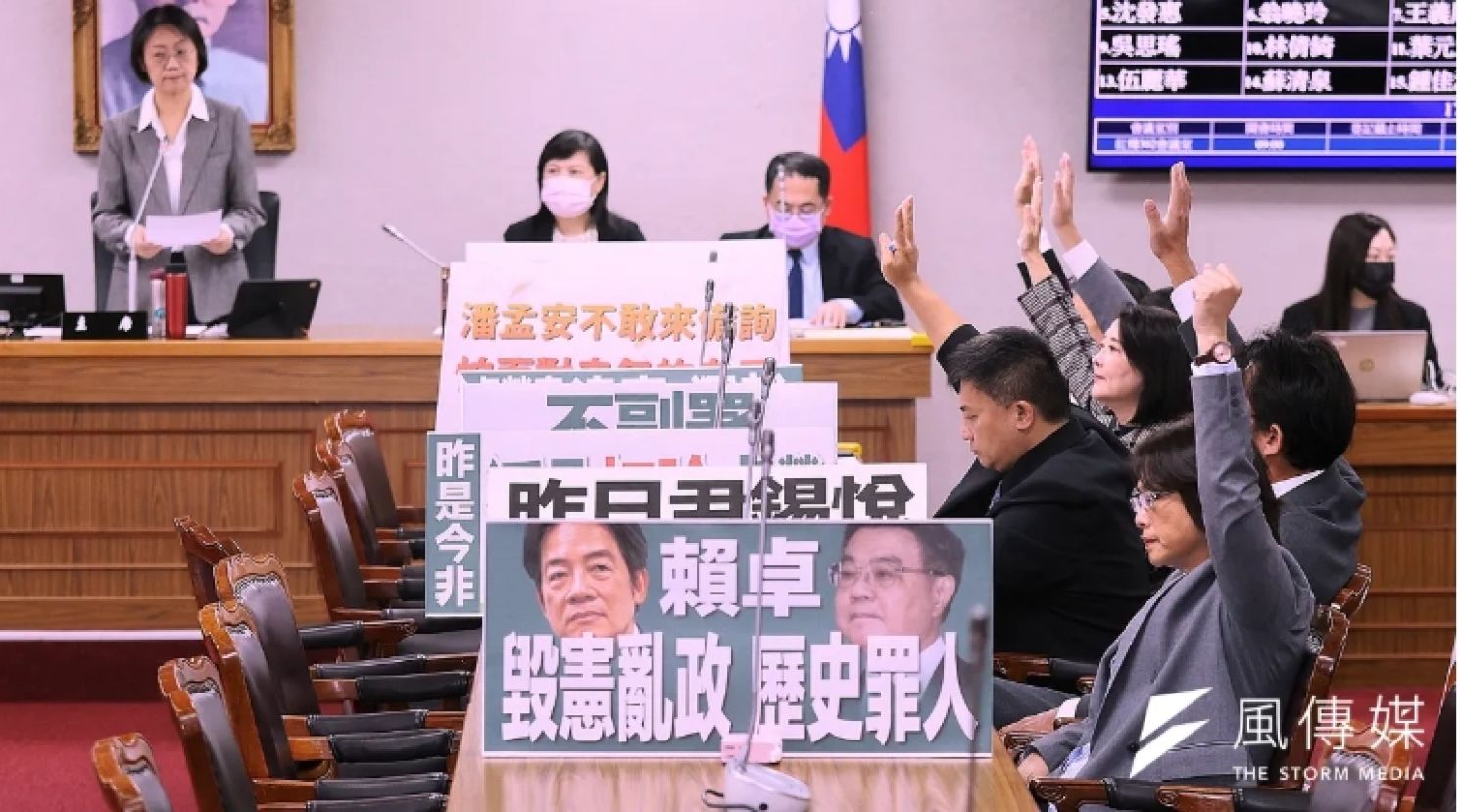
Premier Refuses to Counter-sign and Implement Bills Passed by Legislative Yuan
United Daily News Commentary, December 15, 2025
The plan by the administration of President Lai Ching-te to adopt measures of non-countersignature and non-implementation regarding the Fiscal Allocation Act disregards the majority will of the legislature and uses administrative power to nullify legislative authority. This not only creates a grave constitutional precedent but also intensifies confrontation between the ruling and opposition camps, offering no help in advancing national governance. From the Democratic Progressive Party’s (DPP) legislative caucus to its governing team, over the past year they have repeatedly accused opposition parties of destroying the Constitution and undermining governance. Yet those truly doing so are the governing authorities themselves. Or rather, the real question is: does the Republic of China Constitution still exist in the minds of the DPP administration?
Since the Lai administration took office, the current situation of a minority ruling party facing a majority opposition in the legislature has indeed posed challenges to governance. However, instead of considering a coalition government or pursuing cross-party reconciliation, the Lai administration chose a different path. It first launched large-scale recall efforts, believing it could overturn its legislative minority status. When public opinion once again made clear that it does not welcome one-party dominance without oversight, the Lai administration has still shown no sign of reflection and has instead moved toward further intensifying social divisions.
The Fiscal Allocation Act has gone unamended for a quarter century. During his tenure as mayor of Tainan, President Lai strongly called for its revision. Yet it was not amended during his time as premier, and after becoming president, when the opposition Kuomintang (KMT) and Taiwan People’s Party (TPP) proposed amendment bills, the Executive Yuan delayed until recently before submitting its own version. When legislation passed by a parliamentary majority is rejected by the ruling party, the government accuses the opposition legislative majority of violating the will of the people. But who determines the will of the people? Is the will expressed through majority decisions in the legislature not the will of the people? Do all those who disagree with the DPP simply not count as public opinion?
Under the reality that the Executive Yuan has repeatedly failed to submit its own draft bills, has been unable to engage in rational policy discussions with the Legislative Yuan, and that the Constitutional Court has been paralyzed due to confrontation between the president and the opposition, some pro-independence scholars have advocated that the Executive Yuan adopt non-countersignature and non-implementation as a means to resist the legislative majority. This approach precisely highlights a mindset of unlimited administrative power expansion, anti-democracy, and even a drift toward dictatorship, fundamentally ignoring the existence of the R.O.C. Constitution.
Under Article 57 of the Constitution, prior to constitutional amendments, if a reconsideration motion was rejected, the premier was required to “accept the decision or resign.” Although the constitutional amendments removed the requirement of “resignation,” Article 3 of the Additional Articles of the Constitution clearly stipulates that if a reconsideration is rejected by a majority of legislators and the original bill is upheld, then the premier “shall immediately accept the decision.”
Yet these constitutional amendments have led some to derive the notion that after a failed reconsideration, the premier may adopt political tactics of non-countersignature to resist. Such arguments—on which even so-called pro-green scholars disagree—have nevertheless been endorsed by the president and the Executive Yuan, without any consideration that this would not only amount to administrative veto of legislation but effectively allow the executive to confiscate legislative power. It also exposes the ruling party’s domineering posture to the public. After all, when a premier can fail reconsideration motions eight times—an unprecedented situation globally—without bearing any political responsibility, and now further insists on using non-countersignature and non-implementation to confront majority public opinion, it demonstrates complete disregard for democracy, the rule of law, political accountability, and the Constitution.
Last year, some also suggested that President Lai should refuse to sign and promulgate amendments related to legislative powers that the ruling party regarded as bad laws. At that time, party and government figures argued that whether a law violates the Constitution falls exclusively within the jurisdiction of the Constitutional Court, and that the president has no power of constitutional review and cannot refuse promulgation based on personal judgment. They also stated that refusal to promulgate laws would leave legislation in a state of uncertainty and undermine the principles of separation of powers and checks and balances.
The same reasoning can now be applied to examine the Executive Yuan’s attempt to resist legislative authority through non-countersignature and non-implementation. The premier is not only positioning himself as a grand justice and treating the legislature as a subordinate, but this emperor-like arbitrariness fundamentally undermines the most basic principles of separation of powers and checks and balances in a democratic system. It does nothing to resolve the current constitutional deadlock and instead risks leading the country into an even deeper impasse.
During his tenure as mayor of Tainan, President Lai was criticized by the Control Yuan for sidelining the city council’s legislative authority, being deemed to deviate from democratic and rule-of-law principles and to damage the constitutional system. Now that Mayor Lai has become President Lai, his contempt for the constitutional framework remains unchanged. If laws passed by the legislature can be selectively implemented or ignored by the Executive Yuan at its own discretion, then will it be the case in the future that any law displeasing pro-independence forces can simply be left unsigned and unimplemented? Once such a constitutional precedent is set, it effectively declares Taiwan’s entry into constitutional dictatorship.